When the Pebble Finally Hit the Water

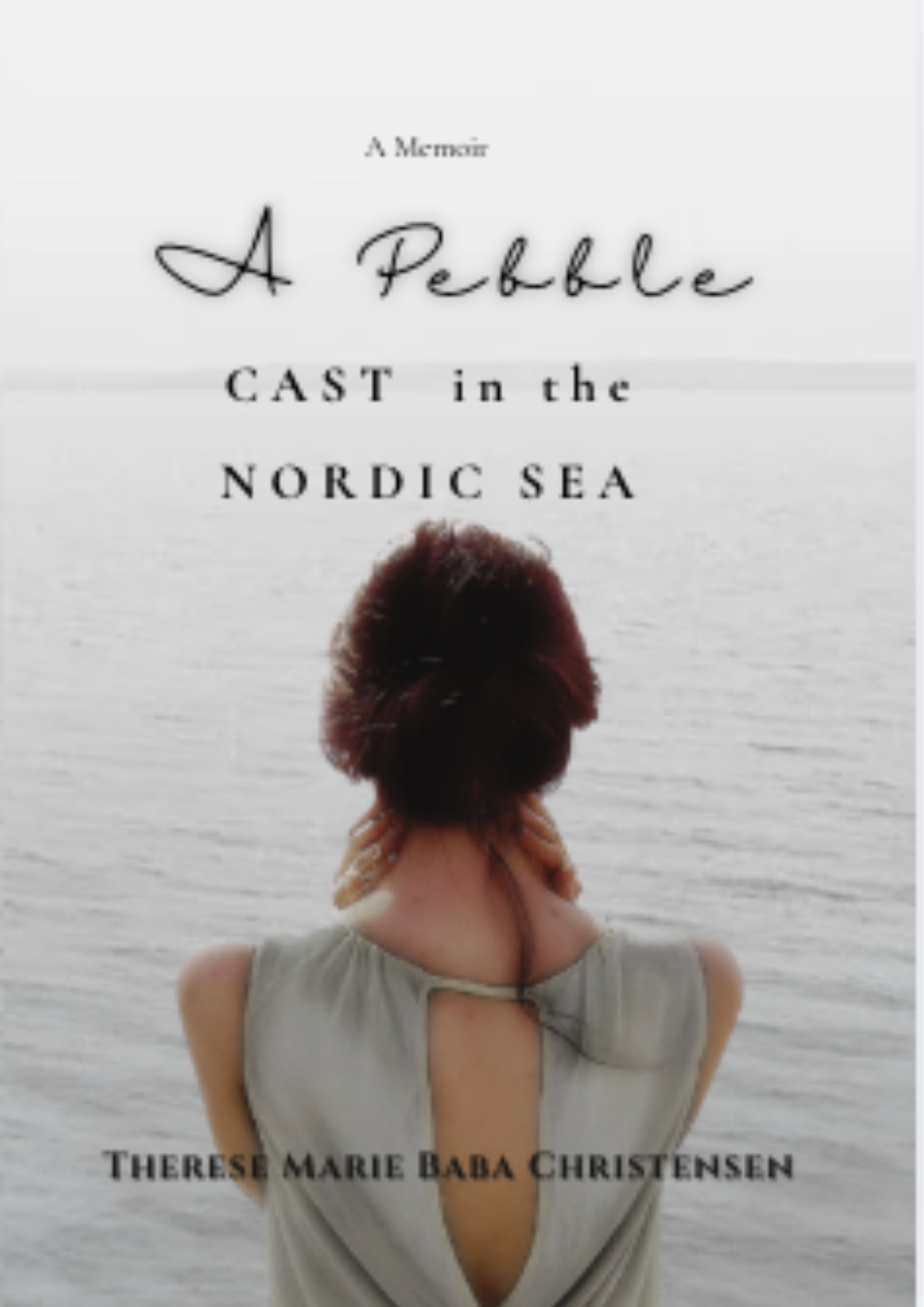
My book, A Pebble Cast in the Nordic Sea, is out in the world.

It feels unreal to say that sentence. Writing a book was one thing–living with it, doubting it, accepting it– but releasing it? That’s a different kind of vulnerability. It’s baring your soul to people who you might have only seen the performative version of you. It’s letting people you might have held less than 5-minute conversations to see the unglamorous version of you for the goal of owning your voice and to be a possible anchor for someone who might be feeling alone and see a mirror in the pages. It’s not mine anymore; it now belongs to the world.

It’s a mix of pride and peace with a thin thread of fear woven in. Pride, because this story carries my voice and the voices of women who had been silenced too long. Peace, because I finally let go. And fear, because releasing truth– especially lived truth–is never neat.

When I hold the printed pages now, I don’t see perfection. Oh, it is far from perfect. But there is stillness. I know the indecisiveness in certain parts and pages, but I can also remember how rebellion and the sheer audacity to dare won.

This memoir is not just mine–it’s a collective exhale. It is for the woman who left home and found both freedom, loneliness, to belong and be othered at the same time in another country. It’s for the woman who questions the rules she was told to obey. It’s for anyone who has ever stood at the edge of the unknown with shaking hands, steady eyes, and decided to leap anyway.

I wrote this hoping that someone, somewhere, will pick it up and feel less alone. That they’ll recognize themselves in the pages and think, maybe I was brave in ways the world didn’t see.

I’ve learned that once you release something honest, it no longer belongs only to you. It is now for everyone who finds a fragment of themselves inside it. And that in itself is beautiful. The real ripple–and I’m grateful it has begun.

Therese Marie Baba Christensen

To My Daughter, If Ever One Day

By Therese Christensen

There was a time in my life when I worked in the field, supporting women who had survived violence. Some days were heavier than others—days when I’d find myself sitting alone in a café, trying to process what I had witnessed, feeling like the weight of their stories had followed me home.

Sometimes, I escaped into romance novels. I bought nearly a thousand Kindle books. It was a safe kind of escape—where endings were predictable, where love was uncomplicated, where everything turned out okay.

But there were days when even fiction couldn’t hold me. Days when the pain I carried wasn’t mine to tell, but still needed a place to go. I was bound by tavshedspligt—a confidentiality agreement—so I couldn’t speak the stories. I wrote instead.

I remember typing these words into the Notes app on my MacBook. At first, I thought I was writing to a future daughter. But really, I think I was writing to the women I had sat with—the girls they once were—before the harm, before the silence.

Maybe I just wanted someone, anyone, to whisper in their ear: You are enough.


🌿 A Note in Retrospect

Reading this again, years later, I notice lines that don’t sit quite right with me now. For instance, the phrase: “If he chooses you as a partner…” feels off. It implies that the woman is waiting to be chosen like her worth depends on someone else’s validation. And that’s not what I believe.

The truth is, I have always believed in a woman’s agency. That has never changed.

But when I wrote this, I was echoing the voices of women in survival mode. So many of them told me they felt lucky just to be the chosen girlfriend or wife. That kind of language can be painful to hear but it’s real. And when someone is in survival mode, logic doesn’t always reach them. What does is compassion. Understanding. A hand extended, not a lecture.

This poem wasn’t meant to be perfect. It was meant to be safe. A quiet offering to women who hadn’t yet remembered their own power– but who were always worthy of it.


To My Daughter, If Ever One Day

Baby,
I know you love him
but never make him your world.

I know you just want to be a good wife,
but never at the expense of forgetting your worth.

I know you value his input,
but never doubt your own capabilities.

I know you’re being understanding of his work,
but don’t forget—you have a life to live too.

You are his equal.
If he chooses you as a partner,
he should see you as one.

Pamper him if you must,
but know the difference between caring for a man
and raising one.

You are not his mother.
You are his wife.

There are things you cannot change about him.
Some lessons come too late to be learned.
So choose wisely.
Take your time.

Know him.
Know yourself.

Marriage is not a marathon.
It’s a daily commitment
to yourself,
to him,
to honoring what you’ve chosen
again, and again, and again.

But since it is a marathon,
you don’t step into it unprepared.
You train.
You rest.
You build your strength.
You know your pace.
You come into it whole
knowing you are bringing something worthy.

Because you are.
And if no one ever told you that
let this be the first time.


Closing Reflection

I wrote this from a place of both exhaustion and hope. And now, with more distance, I offer it again this time with gentleness for the women who are still finding their voices, and for those of us who are still unlearning what we were taught about love, power, and worth.

If this speaks to you, I hope you’ll hold onto it. Share it if it feels right. Or just let it sit quietly with you for a while.

We all deserve to be reminded that we are whole.

Chapter 1, Part 2: Thrown Into a New Reality

Standing in the middle of Copenhagen Airport, I was surrounded by a flood of arriving and departing passengers. My legs were frozen, my thoughts tangled. This was the farthest I’d ever been from home, and reality was setting in: I was completely on my own.

I had just survived my first international flight, a terrifying encounter with the National Bureau of Investigation, and the silent anxiety of pretending I had it all together. But now, the adrenaline was wearing off. The signs were in Danish. The people looked nothing like me. The air smelled different. Everything felt foreign.

My undiagnosed Autistic ADHD kicked in full force. The chaos of noise—announcements, luggage wheels, people rushing past—overwhelmed my senses. I didn’t know what a meltdown was back then, but I remember the symptoms clearly: dizziness, cold sweats, a racing heart. It was the same feeling I would later recognize as a panic attack.

But in that moment, I did what I had always done—I masked. I smiled and kept moving, even though I could barely read the signs.

There was something about how the air hit my face that morning—crisp, sharp, unfamiliar. The colors were different too. Cooler tones. Harsher light.

I wasn’t looking for anything familiar. I was too caught up in the difference—the way everything looked, sounded, even smelled. Strangely, the unfamiliarity soothed me. It felt like stepping into a world that didn’t expect me to belong, and for the first time, that felt like a kind of safety.

“Therese, what have you gotten yourself into?” I remember thinking.

Just then, like a beacon of light, I spotted a young man in a green shirt that read “ASK ME.”
I walked straight to him and asked how to get to my terminal for the domestic flight to Karup.

He kindly explained that I needed to take the free shuttle to Terminal 2, pointing outside.
“Across the street,” he said.

Still high from anxiety and confusion, I asked—very seriously—“Wouldn’t it be better if I just take a cab?”

He laughed. Gently. Not mean, just amused.

I took that laugh in both ways—with curiosity and confusion. Was there something I wasn’t seeing? Was I missing something crucial? I wasn’t angry, just uncertain.

That moment was my first taste of cultural difference, though I wouldn’t fully understand it until much later. I didn’t know then that Denmark is one of the most expensive countries in the world to take a taxi. That laugh wasn’t mocking, but it left me wondering what rules I hadn’t yet learned.

So I thanked him and stepped out of the terminal. The sunlight was bright, but not warm. It had a bite to it. Across the street, I spotted the shuttle stop—a small, glass-covered waiting area. Nothing fancy, just functional.

I stood there alone, soaking it all in. The quiet was surreal. No honking horns, no shouting vendors, no traffic rumbling in the background. Just stillness. A kind of silence that felt both comforting and intimidating. The air was clean, the surroundings orderly—so different from what I was used to. In that stillness, my thoughts felt louder, like they had nowhere to hide.

And then, right there, my suitcase betrayed me.

It popped open with a soft but very public thud, spilling out the organized chaos I had packed just days before—jeans, a sweater, my four pocketbooks (painstakingly chosen because of the limited space), and a folder containing my au pair contract.

My life scattered in front of the Hilton hotel entrance like an accidental overshare.

The bus driver gave me a look that felt like a ticking clock. I scrambled to gather everything.

This wasn’t home anymore.

I shoved the zipper closed and dragged my suitcase onto the shuttle. The seats were clean and stiff, and the windows offered a surreal view of manicured streets and pristine sidewalks.

As the shuttle pulled away, I looked out the window and took my first real breath since landing.

I whispered to myself, You did it.
Even though everything in me was saying, You have no idea what you’re doing.

When we arrived at Terminal 1, I reminded myself to act like I knew where I was going, that I belonged here, that this wasn’t my first rodeo. I repeated the mantra my best friend from high school used to say: “You gotta fake it until you make it.”

I followed the signs with my head up, shoulders back, trying to carry myself like someone who belonged—even if, inside, I was unraveling.

I remember thinking:
No one here knows me.
No one knows my name.
No one knows what I left behind.
No one knows what I’m afraid of.

And for the first time in my life,
I was truly alone.

But also—for the first time,
I was free.

It was the kind of freedom you feel right before you rappel down a cliff—feet on the edge, rope in hand, suspended between trust and terror.


💬 Coming next: Meeting my host family, the open-faced sandwich surprise, and learning what it really means to “start over.”

💙 Have you ever felt completely out of place but knew you had to keep going? I’d love to hear your story in the comments.