When the Pebble Finally Hit the Water

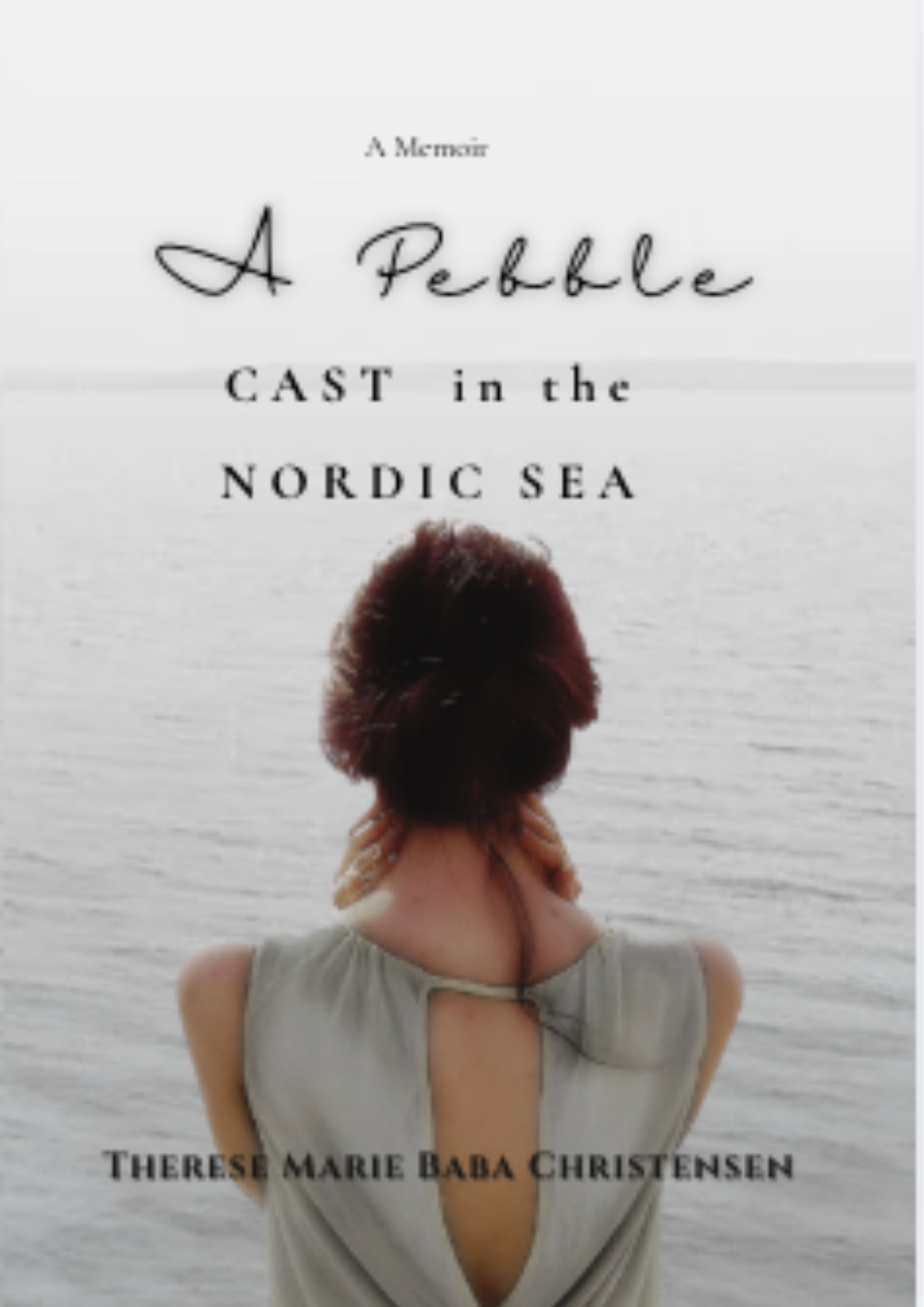
My book, A Pebble Cast in the Nordic Sea, is out in the world.

It feels unreal to say that sentence. Writing a book was one thing–living with it, doubting it, accepting it– but releasing it? That’s a different kind of vulnerability. It’s baring your soul to people who you might have only seen the performative version of you. It’s letting people you might have held less than 5-minute conversations to see the unglamorous version of you for the goal of owning your voice and to be a possible anchor for someone who might be feeling alone and see a mirror in the pages. It’s not mine anymore; it now belongs to the world.

It’s a mix of pride and peace with a thin thread of fear woven in. Pride, because this story carries my voice and the voices of women who had been silenced too long. Peace, because I finally let go. And fear, because releasing truth– especially lived truth–is never neat.

When I hold the printed pages now, I don’t see perfection. Oh, it is far from perfect. But there is stillness. I know the indecisiveness in certain parts and pages, but I can also remember how rebellion and the sheer audacity to dare won.

This memoir is not just mine–it’s a collective exhale. It is for the woman who left home and found both freedom, loneliness, to belong and be othered at the same time in another country. It’s for the woman who questions the rules she was told to obey. It’s for anyone who has ever stood at the edge of the unknown with shaking hands, steady eyes, and decided to leap anyway.

I wrote this hoping that someone, somewhere, will pick it up and feel less alone. That they’ll recognize themselves in the pages and think, maybe I was brave in ways the world didn’t see.

I’ve learned that once you release something honest, it no longer belongs only to you. It is now for everyone who finds a fragment of themselves inside it. And that in itself is beautiful. The real ripple–and I’m grateful it has begun.

Therese Marie Baba Christensen

Chapter 1, Part 2: Thrown Into a New Reality

Standing in the middle of Copenhagen Airport, I was surrounded by a flood of arriving and departing passengers. My legs were frozen, my thoughts tangled. This was the farthest I’d ever been from home, and reality was setting in: I was completely on my own.

I had just survived my first international flight, a terrifying encounter with the National Bureau of Investigation, and the silent anxiety of pretending I had it all together. But now, the adrenaline was wearing off. The signs were in Danish. The people looked nothing like me. The air smelled different. Everything felt foreign.

My undiagnosed Autistic ADHD kicked in full force. The chaos of noise—announcements, luggage wheels, people rushing past—overwhelmed my senses. I didn’t know what a meltdown was back then, but I remember the symptoms clearly: dizziness, cold sweats, a racing heart. It was the same feeling I would later recognize as a panic attack.

But in that moment, I did what I had always done—I masked. I smiled and kept moving, even though I could barely read the signs.

There was something about how the air hit my face that morning—crisp, sharp, unfamiliar. The colors were different too. Cooler tones. Harsher light.

I wasn’t looking for anything familiar. I was too caught up in the difference—the way everything looked, sounded, even smelled. Strangely, the unfamiliarity soothed me. It felt like stepping into a world that didn’t expect me to belong, and for the first time, that felt like a kind of safety.

“Therese, what have you gotten yourself into?” I remember thinking.

Just then, like a beacon of light, I spotted a young man in a green shirt that read “ASK ME.”
I walked straight to him and asked how to get to my terminal for the domestic flight to Karup.

He kindly explained that I needed to take the free shuttle to Terminal 2, pointing outside.
“Across the street,” he said.

Still high from anxiety and confusion, I asked—very seriously—“Wouldn’t it be better if I just take a cab?”

He laughed. Gently. Not mean, just amused.

I took that laugh in both ways—with curiosity and confusion. Was there something I wasn’t seeing? Was I missing something crucial? I wasn’t angry, just uncertain.

That moment was my first taste of cultural difference, though I wouldn’t fully understand it until much later. I didn’t know then that Denmark is one of the most expensive countries in the world to take a taxi. That laugh wasn’t mocking, but it left me wondering what rules I hadn’t yet learned.

So I thanked him and stepped out of the terminal. The sunlight was bright, but not warm. It had a bite to it. Across the street, I spotted the shuttle stop—a small, glass-covered waiting area. Nothing fancy, just functional.

I stood there alone, soaking it all in. The quiet was surreal. No honking horns, no shouting vendors, no traffic rumbling in the background. Just stillness. A kind of silence that felt both comforting and intimidating. The air was clean, the surroundings orderly—so different from what I was used to. In that stillness, my thoughts felt louder, like they had nowhere to hide.

And then, right there, my suitcase betrayed me.

It popped open with a soft but very public thud, spilling out the organized chaos I had packed just days before—jeans, a sweater, my four pocketbooks (painstakingly chosen because of the limited space), and a folder containing my au pair contract.

My life scattered in front of the Hilton hotel entrance like an accidental overshare.

The bus driver gave me a look that felt like a ticking clock. I scrambled to gather everything.

This wasn’t home anymore.

I shoved the zipper closed and dragged my suitcase onto the shuttle. The seats were clean and stiff, and the windows offered a surreal view of manicured streets and pristine sidewalks.

As the shuttle pulled away, I looked out the window and took my first real breath since landing.

I whispered to myself, You did it.
Even though everything in me was saying, You have no idea what you’re doing.

When we arrived at Terminal 1, I reminded myself to act like I knew where I was going, that I belonged here, that this wasn’t my first rodeo. I repeated the mantra my best friend from high school used to say: “You gotta fake it until you make it.”

I followed the signs with my head up, shoulders back, trying to carry myself like someone who belonged—even if, inside, I was unraveling.

I remember thinking:
No one here knows me.
No one knows my name.
No one knows what I left behind.
No one knows what I’m afraid of.

And for the first time in my life,
I was truly alone.

But also—for the first time,
I was free.

It was the kind of freedom you feel right before you rappel down a cliff—feet on the edge, rope in hand, suspended between trust and terror.


💬 Coming next: Meeting my host family, the open-faced sandwich surprise, and learning what it really means to “start over.”

💙 Have you ever felt completely out of place but knew you had to keep going? I’d love to hear your story in the comments.

Foreword: Stories Had to Start Somewhere

In 2008, a young woman of twenty-two years old dared to take the adventure of a lifetime. She left her country and ventured into something new. She was the first from her family to leave the safety of home. She relinquished connections and stability to test her boundaries and see how much further she could go until she broke. Armed with two pieces of luggage—one with her clothes and everything she thought she would need for eighteen months, and the other filled with idealism and naivety, wrapped in a sparkling smile and enthusiasm—she was ready to embrace everything new.

It was monumental.
It was freedom.
It was heartbreak, but it was also an awakening.

I always toyed with the idea of writing about my experience as a young Filipina migrant woman in Denmark. There are so many things I want to share. But I always decided against it because I thought it was too egotistical to write about oneself. I always had this little voice in my head questioning my own experience. How can I have the audacity to think that my experience is so unique that people would actually want to read my story? There are a million Filipino migrant women in the world—so why my story? This bugged me for years.

But then I realized—it was not about me. It was about the chance I was given to be in the middle of so many different lives, witnessing struggles and hurts that all mirrored one another. I was simply there, observing, feeling, and penning them. I could flesh out the experiences through my words and allow the pain and the struggle to be exposed for what they are, without glossing over the authenticity of a migrant’s experience. To open wounds so they wouldn’t fester on the inside. And to let my story speak for the ones who have been silent for too long.

Stories were written about us—we listened to what was told about us. But now, it’s time to reclaim the narrative, to tell the story from our own lenses and experience. Our stories. Our voices.

We are often seen as “the good” migrant community. Sometimes, we don’t want to challenge that perception because the consequences can be severe for those living abroad, supporting families back home. These consequences range from the instability of one’s right to stay in the country to the fear of losing one’s child after leaving an abusive relationship. There is the fear of being ostracized by the Filipino community for not fitting into the mold of the “good Filipina woman,” even from a continent away. And then there’s the looming fear of the hunger the family left behind might have to face at home.

She—the migrant woman—already juggles multiple identities: a good migrant, a woman, a mother, a wife, a sister, a daughter, a survivor, an adventurer, liberated and shackled all at once. She has to play all these roles flawlessly, but who taught her that these are the rules?

We were taught to play by the rules.
We were taught to always obey authority.
We played by the rules, we obeyed authority, but we forgot that the game had changed.
The rules we learned didn’t apply to our current situation, and the authority we were told to respect crossed our boundaries. They took our “no’s” as “yes,” and our silence as acceptance and submission.

Yet, we still want to be the “good migrant.” The woman who gives her warmth and smile. But sometimes you can still be a “good migrant” who smiles—a smile wrapped with a meaningful “fuck you” to whoever thought of you as nothing more than a doormat.

They said I had good material to write a book. That my collated experience as a migrant woman working for migrant women would be enough to break the silence. But then I paused.

Silence.
Writing.
Thoughts in images flashed before my eyes so fast, like 200 km/h. Each frame a story demanding to be told.

Can I really do justice to their stories? Will my writing be good enough for even a slight change? In the safety of my own home, where I hug my boys to sleep each night and share a warm blanket with my husband, there is a fight. A fight beyond me, beyond my fears. A fight that I still burn for—a battle raging against patriarchy.

The current political climate in Denmark tends to erase the existence of these migrant women in subtle ways, smothering them into silence with policies that leave them vulnerable. Their narratives are wiped out, their experiences invalidated, as their silent cries are ignored.

I was at a conference in Cairo, talking to someone about our advocacy. He told me that he fully understood he wouldn’t see the impact of his work in his lifetime.

I replied,
“We are but a pebble—I’m not naïve to not consider that—but I believe in the ripple.”

This book is my pebble.
I’m casting it into the cold, still waters of the Nordic Sea, hoping for a ripple wide enough to shake the silence.


Chapter 1, Part 1: Young Idealist – The Beginning of a Journey

I was rocking my white ribbed tank top, blue low-rise jeans, a pair of brown suede boots, and a brown furry factory-defect Abercrombie and Fitch jacket. It was the most outrageous outfit to wear for an early summer morning in July 2008. But there I was, stepping onto Danish soil for the first time at Copenhagen International Airport—excited, nervous, and completely unaware of the whirlwind that lay ahead.

Inside my backpack was my passport, freshly stamped with a tourist visa for Denmark. But I wasn’t here to be a tourist. I was about to start a new life as an au pair for a Danish family in Jutland.

Getting here hadn’t been easy. Securing an au pair visa required navigating layers of bureaucracy back home in the Philippines. But the real adventure began long before I even boarded the plane.

I had been singled out by an agent from the National Bureau of Investigation during random checks for departing passengers at the airport. There were long lines of travelers queuing for early baggage drop-off, and as I stood there waiting, the agent spotted me.

“Where are you going?” he asked.

“Denmark,” I replied.

“Traveling as a tourist?”

“Yes,” I added, keeping my face neutral.

He nodded, then motioned for me to follow him to their office. That was the moment my fate for the day became uncertain.


Coming Next: Chapter 1, Part 2: Thrown Into a New Reality

My arrival in Denmark, navigating a foreign airport, and the moment I realized I was truly alone for the first time.

💬 Have you ever faced an unexpected obstacle just before a big life change? Share in the comments.